Transcription of Dutch Intonation
This third edition features an improved users interface.
It is fully operative, with missing functions that are indicated in the text.
ToDI 3.0
September 2026
Introduction
Intonation plays a central role in language structure and language use. Interactions with the morphosyntactic structure will lead to semantic differences, like that between (1) and (2) or that between (3) and (4). Here, the capitalized syllables have a 'pitch accent', also known as a 'sentence accent'. These terms distinguish it from word stress, which is what distinguishes the Dutch noun onderwerp 'topic' from the verb from onderwerp '1sg:subjugate'.
Example (1) is the correct reading of a sign at the entrance of a park, which carries the conditional implication 'in case you bring a dog', while (2) is a jocular reading suggesting that we should keep talking to dogs, directly or on the phone, with the aim of delaying their departure. The contrast reproduces an English minimal pair provided by Halliday (1967: 38, cf Gussenhoven 1983).
(1) U moet HONden aan de LIJN houden
(2) U moet HONden aan de lijn houden
Next, a speaker of (3) indicates that a holiday in Monaco would be much like an earlier holiday in France, Monaco's only neighbouring country. The speaker of (4) may feel much the same about the suggestion, but by not placing a pitch accent on Frankrijk reveals their misconception that Monaco is part of France. This is because the absence of a pitch accent on a word signals an appeal to a preceding occurrence of its referent.
(3) Vakantie in Monaco? Ik ben al eerder in FRANKrijk geweest
(4) Vakantie in Monaco? Ik ben al EERder in Frankrijk geweest
A removal of intonation from language use, which happens when we sing, will make stammerers lose their stammer and non-native speakers lose a great deal of their foreign accent (Hagen et al. 2011). Rather than encouraging people to sing their way through life, this illustrates the intriguing position of intonation. The topic is greatly underrepresented in linguistics programmes and language descriptions.
This course intends to contribute to filling that gap for Dutch by this interactive course in the transcription of Dutch intonation contours as occurring in brief spoken utterances. These transcriptions make use of tones, like H (high) and L (low), just as phonetic symbols for vowels and consonants are used to transcribe the pronunciation of words in dictionaries. Doing this course will make you aware of
- where the sentence accents are
- which of the language's pitch accents are used for each sentence accent
- how a sentence is divided in intonation phrases
- what boundary tones occur at their edges
It will enable you to read the transcription of intonation contours in linguistic examples of Dutch and to write these yourself (see for instance the section on Intonation in Taalportaal, vanaf release 2017).
By pitch we mean the auditory impression of the variation in the frequency of vibratory opening and closing events of the vocal folds. It is known as f0 ('f-zero' or sometimes 'f-nought') and is measured in Hz (here, the opening-and-closing events per second). The course's methodology is based on an auditory and visual inspection of the f0 of an utterance. Each exercise, which contains 12 utterances, focuses on a particular aspect of intonation contours. After the first elementary exercises, they invite you to determine which tone label must be inserted at the beginning or end of an intonation phrase (the boundary tones) and at every sentence accent.
You will quickly develop a better ear for pitch movements and for differences between intonation contours. This is done by allowing you to listen to what the intonation contour for any legitimate transcription sounds like. That is, the 'resynthesis' function will reproduce the original utterance with an artificial intonation contour based on the correct transcription, which is given in the Key, but It is often useful to provide incorrect transcriptions, just to listen to what these sound like.
In all cases, you can inspect the pitch track of the intonation contour, whether original or artificial. This will develop your understanding of how your perception of pitch relates to the way the vibration rate the vocal folds varies across the utterance. This is further facilitated by a comparison between the pitch track of the original contour with that of the artificial one produced from a correct transcription.
Your goals may be less ambitious than an ability to transcribe all the intonation contours that speakers of Dutch might use. Because the Dutch intonation system is quite large compared to that of Swedish or even French, that aim would require a sustained and dedicated effort. Since many students will have more modest goals, the course is divided into two parts. Completing Part I will ensure mastery of the three course objectives listed above, though without mastering the full set of melodic choices. It concentrates on the more usual intonation contours, the ones with H* in their pitch accents. It also covers some important regularities in the locations of pitch accents, in particular those that are rhythmically motivated.
The topic of each chapter is prefaced with an explanation of the intonational phenomena concerned. The audio illustrations in those introductions have a speaker icon and can be played by clicking on the example. You can save those sound files to disk and process them in your speech analysis software, for which we recommend Praat, which is used by our program for all operations. It is the world's standaard speech analysis package. Click the right mouse button while hovering over the example space, selecting the appropriate menu option to do this. All sound files are 16-bit, 16KHz Windows.wav-files.
The User Interface
The analysis uses three sets of tone labels, to be used for every intonational phrase. The full set is:
| 1. | Initial boundary tones: | %H, %L, %HL |
| 2. | Pitch accents: | H*, H*L, !H*, !H*L, H*LH, L*, L*H, LH*L, L*!HL |
| 3. | Final boundary tones: | H%, L%, % |
The screenshot below shows the second item in Exercise A1. Tone labels for pitch accents correspond to text buttons below the relevant words in the written version of the utterance. A button to the left of that text specifies the initial boundary tone, while a button to the right is used for the final boundary tones. The tone labels are either pre-specified (white) or can be chosen from pull-down menus (green).
A choice of the 'empty' symbol Ø will remove any tone label you entered earlier. Note that the symbol [%] by itself indicates the toneless end of the intonation phrase, which must be specified for the resynthesis rules to work.
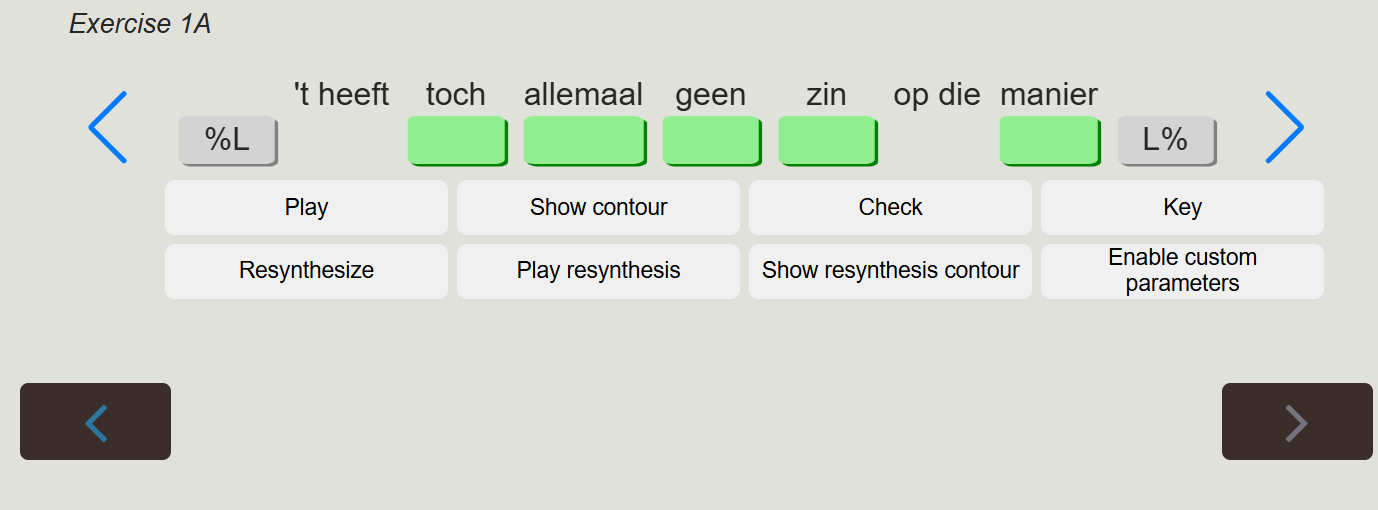 Screenshot of item 2 in Exercise 1A.
- To hear what the intonation of a correct or incorrect transcription sounds like, you first press the Resynthesis button in the second row, and click the 'Play resynthesis' button when it lights up, about a second later. As said, you will find it useful to try out different incorrect transcriptions, which will clarify in an efficient manner what it means for a pitch accent to occur on one or more words in a sentence. You can see the resynthesized contour by clicking the next button, which appears below that of the original utterance if it is present.
Our f0 implementation model is a simplified version of that in Ladd (1987), which integrates the accentual downstep function from Pierrehumbert (1980. Knowing how it works is only essential once the new parameter controls have been activated, which feature is still under development.
Briefly, the resynthesis of the utterance with an artificial intonation contour requires each tone in the string of tone labels to be translated into minimally one target, with a time stamp on the horizontaL axis ('alignment') and an f0 value on the vertical axis ('scaling'). In many cases, a tone will give rise to two adjacent targets, which typically improve a tone's perceptibility. The f0 contour consists of the interpolations between consecutive targets. The initial alignments in an intonation phrase (IP) are (1) its beginning, (2) its end and (3) the beginning of the rhyme of the stressed syllable of every accented word. One target for the initial boundary tone and one target for a final boundary tone are placed at the respective edges of the IP. Other targets are defined using three distance measures. Any target that is defined can be used as a reference for additional targets.
STARTIME determines the alignment of the first target of the starred tone (T*). It is placed after a proportion of the duration of the voiced portion (vp) of the rhyme, standardly 40%. To clarify, the voiced portion of the rhyme is the part you can hum a melody on, thanks to the unobstructed air passage during 'sonorant' sounds. In the following stressed syllables, voiced portions are underlined: aan, zaak, steil, neef, berg, jasje, lende, winkel, striemen.
TOTIME determines the distance in ms to an upcoming reference point, standardly 90.
FROMTIME determines the distance in ms from a preceding reference point, standardly 100.
The f0-model determines the scaling of the targets for H and L. The difference between H and L, the 'pitch range' or 'pitch width', is defined by a parameter W. The pitch range is calculated within a wider f0 space defined by two parameters. A low reference point is given by the reference frequency', Fr, above which a normalization value N sets the mean f0 between H and L, also known as the 'pitch register'. In addition, there is a downstep factor for !H*-tones, da, which is standardly 0.7 of the value for the preceding H* or !H*, where !H* is a downstepped H*-tone. There is also a phrasal downstep factor, dp, standardly 0.9, which lowers the pitch of both H and L targets in the entire upcoming phrase, which has not yet been implemented in this version.
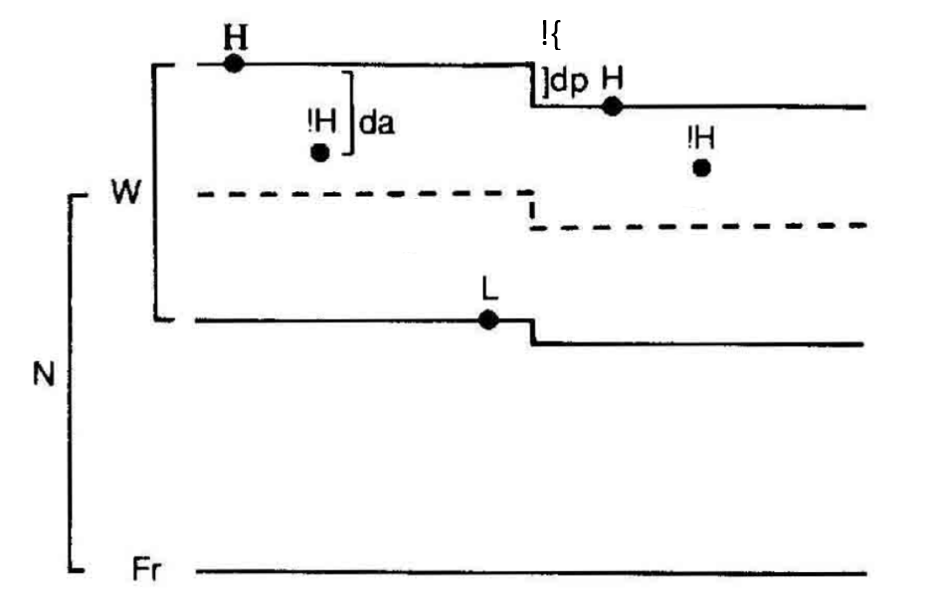 Graphic representation of the f0-model (after Ladd 1987, van den Berg et al. 1992).
Some history
The ToDI analysis was developed over many years, from 1981 to 1998, and formally published in print in Gussenhoven (2005). A description of British English was published in chapters 14 and 15 in Gussenhoven (2004). It featured in the earlier web-based ToDI course (https://todi.cls.ru.nl (1999-2025) CreditsToDI). ToDI 1.1 lacked a resynthesis function, which was introduced in ToDI 2.1, first on the basis of an artificial segmental signal based on MBROLA diphone resynthesis and from 2015 by means of PSOLA resynthesis on the basis of the original utterance. The acoustic analyses, the annotations, and the resyntheses were and are done with Praat (Boersma & Weenink 1992-2026).
-
ToDI is not a model for analyzing and annotating the pitch contours of languages in general. It is a phonological analysis of the intonation of Dutch. Just as the vowels of Dutch will not provide an adequate framework for the analysis of the vowels of Finnish or Standard Mandarin, so ToDI will not be useful as an analytical framework for the analysis of French or Cantonese, say. As it happens, the intonation grammars of the standard varieties of English, Frisian and German are nearly identical to that of Standard Dutch, so that ToDI can be used for those languages without adaptation. It was adopted for German by Peters (e.g. 2009, 2010), for British English by Grabe et al. (1998), who termed it IViE and used it in the project Intonational Variation in the British Isles, and for Frisian by Hanssen (e.g. 2017, 2022). See here diff-IViE.pdf for some specifically IViE features.
-
ToDI was inspired by two approaches to the analysis of the intonation of West Germanic languages. First, it adopted the general model developed by Pierrehumbert (1980) for the analysis of American English intonation, which distinguished the phonology from its phonetic implementation, for which she used a target-interpolation model. This means that segments, whether vowels, consonants or tones, are realized as points in a time-f0 coordinate space ('targets') and that the contour arises from interpolations between targets. Earlier accounts of intonation have assumed grammars that consist of contour sections (Fall, Rise, etc). As will be clear, in our course, the transcription is the phonology and the resynthesis is the phonetic implementation.
The phonological analysis that ToDI is based on differs significantly from Pierrehumbert's (1980). Conceptually, ToDI's analytical decisions were those of the British tradition of intonation analysis, in which a standard accent-marking rising-falling pitch contour was presented as a Fall (in ToDI: H*L), rather than as a Rise followed by low edge tones (in Pierrehumbert's notation L+H* L-) (Palmer 1922; O'Connor & Arnold 1973; Wells 2006). The first analysisis of Dutch intonation was only developed in the 1970s at the Institute of Perception Research in Eindhoven (the 'IPO grammar of Dutch intonation') and it has been useful to the development of ToDI in various ways ('t Hart et al. 1990; Collier & 't Hart 1981).
References
Beckman, Mary E.; Ayers, G.M. (1994). Guidelines for ToBI transcription. Version 2.0. Ms Ohio State University.
Cohen, A,; Collier, René; 't Hart, Johan (1990). A Perceptual Course
Collier, René; 't Hart, Johan (1981). Cursus Nederlandse Intonatie. Leuven: Acco.
Grabe, Esther; Nolan, Francis; Farrar, Kimberley J. (1998). IViE - a comparative transcription system for intonational variation in English*. Proc. 5th International Conference on Spoken Language Processing* (ICSLP 1998), paper 99, doi: 10.21437/ICSLP.1998-583.
Gussenhoven, Carlos (1983). Focus, mode and the nucleus. Journal of Linguistics 19: 377-417.
Gussenhoven, Carlos (1985). Deze stijging is dus een daling. In: Handelingen van het Nederlandse Filologencongres 38.
Gussenhoven, Carlos (1988). Adequacy in intonation analysis: The case of Dutch. In H. van der Hulst & N. Smith (eds.) Autosegmental Studies on Pitch Accent. Dordrecht: Foris.
Gussenhoven, Carlos (1991). Tone segments in the intonation of Dutch. In Thomas F. Shannon & Johan P. Snapper (eds.) The Berkeley Conference on Dutch Linguistics 1989. Lanham (MD): University Press of America.
Gussenhoven, Carlos; Rietveld, Toni (1992). A target-interpolation model for the intonation of Dutch. In Proc. 3rd International Conference on Spoken Language Processing (ICSLP 1998). 1235-1238.
Gussenhoven, Carlos (2005). Transcription of Dutch Intonation. In Sun-Ah Jun (ed.) Prosodic Typology and Transcription: A Unified Approach. Oxford: Oxford University Press.
Gussenhoven, Carlos, (2016). Analysis of intonation: The case of MAE_ToBI.* Laboratory Phonology 7(1): 10. doi: https://doi.org/10.5334/labphon.30*
Hagen, Miranda; Kerkhoff, Joop; Gussenhoven, Carlos. (2011). Singing your accent away, and why it works. ICPhS XVII, 799-802.
Halliday, Michael A.K. (1967). Intonation in Grammar and in British English. The Hague: Mouton.
Hanssen, Judith (2017). Regional variation in the realization of intonation contours in the Netherlands. Utrecht: LOT publications (447).
Hanssen, Judith; Peters, Jörg; Gussenhoven, Carlos (2022). Responses to time pressure on phrase-final melodies in varieties of Dutch and West Frisian. Journal of Phonetics 93: 101-150.
Ladd D. Robert (1987).Description of research on the procedures for assigning F~0~ contours to utterances. CSTR text-to-speech project report, Centre for Speech Technology Research, Edinburgh(1972) Intonation of Colloquial English
O'Connor, J. D. ; Arnold, Gordon F. (1972). Intonation of Colloquium English. Hoboken NJ: Prentice Hall.
Palmer, Harold E. (1922). English Intonation, with Systematic Exercises. Cambridge UK: Heffer.
Pierrehumbert, Janet B. (1980). The Phonology and Phonetics of English Intonation. PhD dissertation, MIT.
Peters, Jörg (2009). Intonation. Duden - Die Grammatik. Chapter 2 (DUDEN Series vol. 4). Mannheim, 2009, 95-128 [8th revised edition].
Peters, Jörg (2010). Tonal variation in West Germanic languages. In: Thomas Stolz, Esther Ruigendijk & Jürgen Trabant (Eds.), Linguistik im Nordwesten. Beiträge zum 1. Nordwestdeutschen Linguistischen Kolloquium (Bremen, 10-11 October 2008). Bochum: Brockmeyer. 79-102.
´t Hart, Johan; Collier, René; Cohen, Anthonie (1990). A Perceptual Study of Intonation. An experimental-
Taalportaal (2026): The linguistics of Dutch, Frisian and Afrikaans online. Dutch - Phonology - Accent and intonation - Intonation
van den Berg, Rob; Rietveld, Toni; Gussenhoven, Carlos (1992). Downstep in Dutch: Implications for a model. In Gerard J. Docherty & D. Robert Ladd (Eds.), Papers in Laboratory Phonology II: Gesture, Segment, Prosody. Cambridge: Cambridge University Press. 335-359.
Wells, J.C. (2006) English Intonation. Cambridge University Press.